
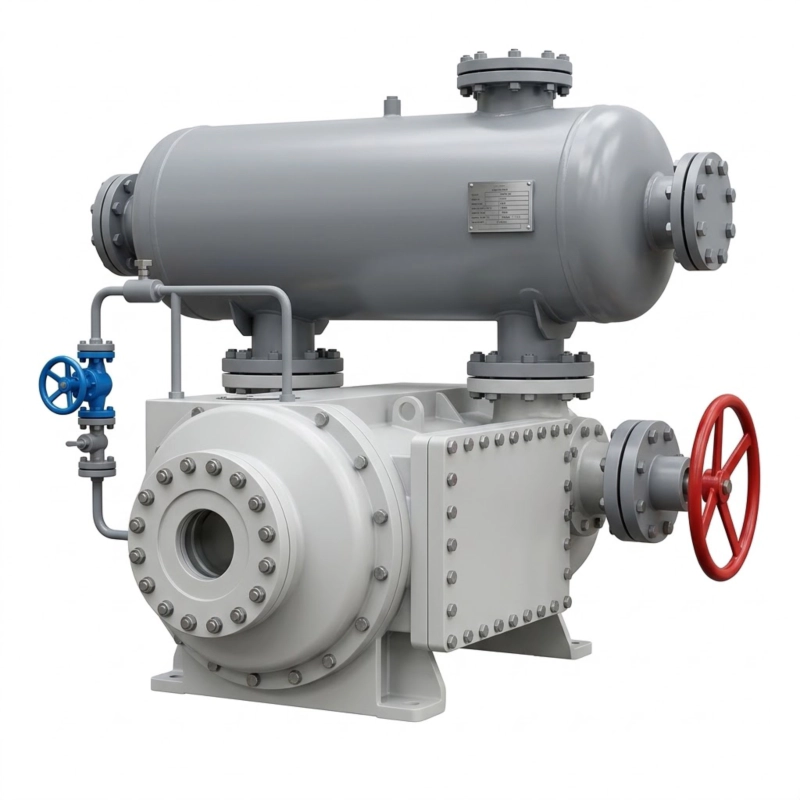
4MW-48/12-55 Hydrogen Circulation Compressor
Boost 2880 Nm³/h of hydrogen from 12 to 55 bar with the 4MW-48/12-55 Oil-Free Circulation Compressor. ATEX-certified for petrochemical hydrocracking loops.
1. The Macro-Economics of High-Pressure Hydrocracking and Desulfurization
In the vanguard of global petrochemical refining and advanced synthetic fuel manufacturing, high-pressure hydrogen loops are the foundational infrastructure driving deep desulfurization and hydrocracking processes. These extreme chemical reactions require massive volumes of hydrogen to be continuously forced through dense catalyst beds at incredibly high pressures to break heavy hydrocarbon bonds and strip sulfur compounds. Because the reaction consumes only a fraction of the hydrogen per pass, the massive volume of unreacted gas must be captured, forcefully re-pressurized from 12 bar back up to a punishing 55 bar, and relentlessly injected back into the reactor matrix.
Executing this massive kinetic action—boosting 2880 cubic meters of highly reactive, elusive diatomic hydrogen an hour across a brutal 4.5:1 pressure ratio—presents an utterly terrifying mechanical engineering challenge. If standard lubricated compressors are deployed in this loop, high-pressure mechanical forces will aggressively inject hydrocarbon lubricating oil directly into the circulating gas. This oil vapor will instantaneously coat and poison the multi-million-dollar reactor catalyst beds, completely destroying the chemical yield and forcing catastrophic plant shutdowns.
El 4MW-48/12-55 Oil-Free Hydrogen Circulation Compressor is fundamentally engineered to mathematically neutralize these existential chemical risks. Operating entirely dry without a single drop of liquid oil in the compression cylinders, it preserves the absolute purity of your extreme-pressure reactor loop. By deploying advanced aerospace-grade extreme-pressure PTFE dynamic sealing arrays and a heavily fortified, nitrogen-purged API-618 isolation architecture, it mathematically guarantees zero explosive hydrogen leakage, acting as the ultimate, unbreakable continuous-duty kinetic driver for massive petrochemical refining.
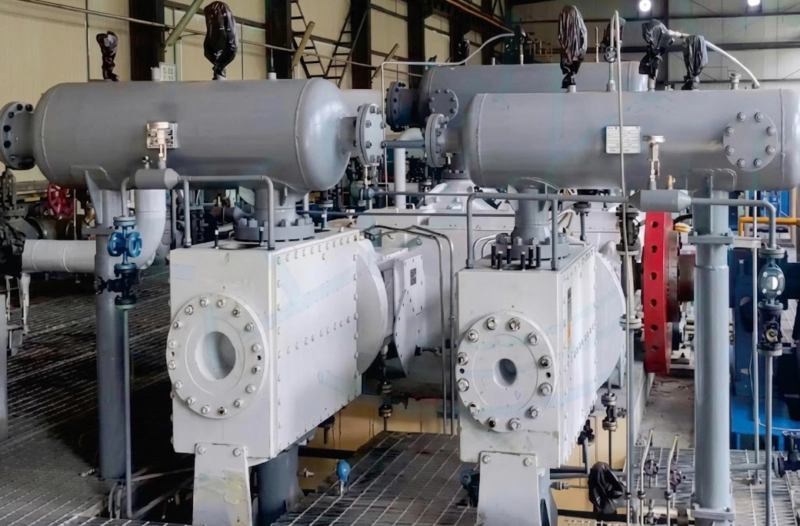
Figure 1: The 4MW-48/12-55 Severe-Duty Circulation Assembly. Meticulously designed for massive volumetric boosting (2880 Nm³/h). Notice the extremely heavy-wall, forged stainless steel high-pressure piping networks and intrinsically safe electrical housings mandated for strict ATEX Zone 1 explosive environments.
2. Exhaustive Technical Specifications & 55-Bar Loop Envelope
Precision fluid dynamics scaled to process 2880 Nm³/h of hydrogen against a brutal 55-bar discharge wall mandates an entirely bespoke mechanical approach. Bridging a massive pressure differential from 12 bar to 55 bar generates immense adiabatic heat and catastrophic dynamic rod loads, strictly requiring forged steel construction and highly precise multi-stage thermodynamic mapping. The following comprehensive technical parameters deeply define the uncompromising, explosion-proof operational envelope of the 4MW-48/12-55 model.
| Technical Parameter | Nominal Value / Engineering Specification |
|---|---|
| Model Designation Architecture | 4MW-48/12-55 (Severe-Duty High-Pressure Circulation Series) |
| Approved Circulation Medium | Pure Hydrogen (H&sub2;), Toxic/Corrosive Syngas Mixtures |
| Volumetric Flow Rate (Capacity) | 48.0 Nm³/min (2880 Nm³/hour) – Continuous Baseload Duty |
| Nominal Suction (Inlet) Pressure | 1.2 MPa (12.0 bar / approx. 174 psi) |
| Target Discharge Pressure | 5.5 MPa (55.0 bar / approx. 797 psi) |
| Thermodynamic Architecture | Strict Multi-Stage Sequential Compression with Deep Intercooling |
| Kinematic Frame & Layout | Heavy-Duty 4MW-Type (Symmetrical Balanced-Opposed Horizontal) |
| Gas Purity Certification | 100% Absolutely Oil-Free (Zero Catalyst Poisoning Guaranteed) |
| High-Pressure Sealing Material | Proprietary 55-Bar Bronze/Graphite Reinforced PTFE Matrix |
| Main Drive Motor Power | 350 kW to 450 kW (Variable Frequency Drive / Ex-d Compliant) |
| Explosion-Proof Certification | ATEX Zone 1 / Class 1 Div 1 Intrinsically Safe (Ex d IIC T4) |
| Manufacturing Compliance Codes | API-618 (Type C Distance Piece), ASME Section VIII Div 2 |
Hydrogen Embrittlement Advisory: High-velocity pressurized hydrogen at 55 bar interacts dangerously with standard carbon steels, causing a catastrophic metallurgical phenomenon known as hydrogen embrittlement where the steel loses its ductility and violently shatters under stress. The 4MW-48/12-55 completely mitigates this hazard. All internal high-pressure wetted parts—including the multi-stage valves, forged cylinder liners, and heavy-wall intercooler pipework—are meticulously machined from premium Austenitic Stainless Steel (316L) and specialized alloys, mathematically rendering the machine immune to structural embrittlement at extreme circulation pressures.
3. The Fluid Dynamics of 12-to-55 Bar Reactor Boosting
Mechanically boosting 2880 Nm³/h of hydrogen from 12 bar to 55 bar requires conquering an immense 4.5:1 pressure ratio. Hydrogen (H&sub2;) is the smallest diatomic molecule in existence. If a single-stage approach were attempted to bridge this massive gap, the violent adiabatic heat generated would instantly melt the PTFE seals, warp the heavy steel valves, and trigger auto-ignition. Furthermore, the volumetric “slip” past the piston rings against a 55-bar wall would completely destroy the machine’s efficiency.
To mathematically enforce a strict, inescapable thermal and volumetric envelope, the 4MW-48/12-55 utilizes a highly precise, multi-stage sequential compression architecture. The initial massive cylinders intercept the 12-bar flow and elevate it to an intermediate state. The violently heated hydrogen is then routed through immense, heavy-wall 316L stainless steel shell-and-tube intercoolers. Only after the kinetic heat is completely stripped away does the dense gas enter the terminal high-pressure cylinders, which forcefully complete the 55-bar compression without ever exceeding the strict API-618 thermal safety limit of 135°C.
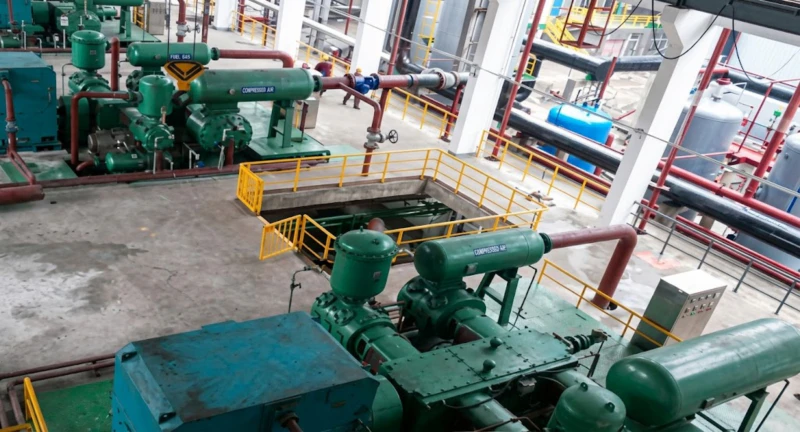
Figure 2: The Multi-Stage Forged Volumetric Cascade. Deployed in a severe-duty petrochemical facility. Notice the incredibly heavy, aggressively flanged stainless steel interstage piping. This layout mathematically guarantees that massive volumes of 55-bar hydrogen are efficiently trapped and progressively compressed without suffering from catastrophic heat accumulation.
Furthermore, the piston rings for the 55-bar terminal stage are radically different from standard air compressor rings. The 4MW-48/12-55 deploys highly specialized, ultra-thick multi-segment PTFE rings aggressively alloyed with aerospace-grade structural bronze powder and high-density graphite. As the 55-bar dynamic pressure forces the rings outward, this rigid composite forms a flawlessly slick, impenetrable dynamic labyrinth seal against the polished forged steel cylinder walls, physically forbidding the ultra-dense H&sub2; from escaping backward.
4. ATEX Explosive Safety & API-618 Nitrogen Purging Architecture
Processing highly combustible hydrogen gas at 55 bar and massive volumes requires a paranoid, military-grade approach to mechanical safety. Because hydrogen ignites with incredibly low energy input, even a microscopic high-pressure leak accumulating inside the crankcase or venting into the reactor housing can lead to a catastrophic, leveling explosion. Standard compressors lack the deep architectural isolation required to handle this extreme chemical threat.
The 4MW-48/12-55 completely isolates the 55-bar hazardous hydrogen gas from both the atmosphere and the lower mechanical crankcase (which contains liquid lubricating oil) by utilizing extended, deeply fortified API-618 Type-C Double Compartment Distance Pieces. The distance piece is a heavy steel structural chamber that physically separates the extreme-pressure cylinder from the crankcase. The piston rod passes through this massive gap. To mathematically guarantee zero hydrogen leakage, this distance piece is continuously flooded with pressurized, inert Nitrogen gas (N&sub2;).
This creates an impenetrable “Nitrogen Buffer Seal.” If microscopic amounts of 55-bar hydrogen bypass the primary high-pressure piston rod packing, it enters the distance piece and is instantly diluted and safely carried away by the flowing inert nitrogen purge, eventually safely venting to an elevated external atmospheric flare. It is physically impossible for the explosive high-pressure hydrogen to migrate down into the oily crankcase, and physically impossible for it to leak outward into your facility. Every single electrical component on the skid is heavily armored and strictly ATEX Zone 1 / Class 1 Div 1 intrinsically safe.
5. Managing Extreme Loads: The 4MW-Type Kinematic Framework
When a massive steel piston forcefully strikes an unyielding wall of 55-bar aerodynamic resistance while displacing 2880 cubic meters an hour, it generates an apocalyptic level of dynamic reciprocating rod load that translates violently back down into the machine’s crankshaft. If a high-capacity circulation compressor is not geometrically balanced, these violently alternating kinetic forces induce catastrophic low-frequency dynamic vibrations capable of rapidly fatiguing the main structural frame and violently shattering the highly sensitive 55-bar reactor piping infrastructure.
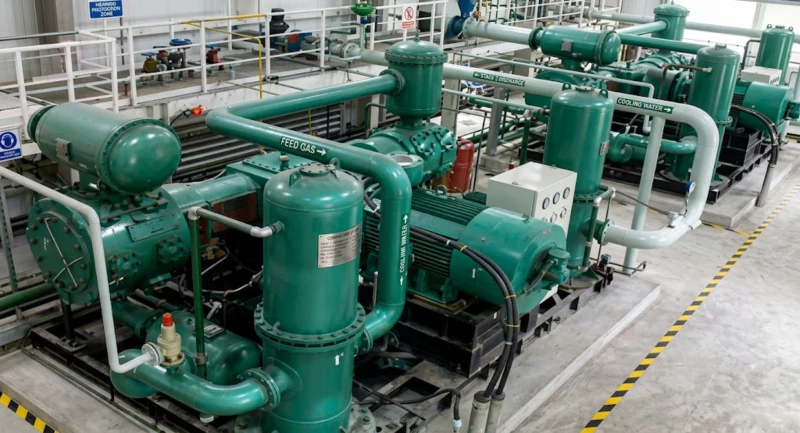
Figure 3: Operational deployment of the heavy 4MW-Type architecture. The massive forged compression cylinders are arranged strictly horizontally across the heavy-duty crankshaft. This geometric symmetry physically and mathematically neutralizes destructive 55-bar vibration, ensuring a perfectly stable platform for 24/7 continuous chemical plant operation.
To completely conquer and domesticate these extreme internal kinetic forces, the 4MW-48/12-55 is forged upon a sprawling, hyper-rigid 4MW-Type Symmetrical Balanced-Opposed Kinematic Architecture. The foundational crankcase is cast from ultra-dense, stress-relieved nodular iron. Because the large reciprocating masses are precisely weight-matched by our senior engineers, their high-speed reciprocating movements perfectly counteract one another across the heavy forged crankshaft. The final result is a massive ~450 kW machine that operates with uncanny, astonishing smoothness, fiercely protecting the structural integrity of your high-pressure gas network.
6. Strategic Industrial Synergies: Hydrocracking & Advanced Manufacturing
As a highly comprehensive global industrial engineering firm, we deeply understand that circulating 2880 Nm³/h of hydrogen at 55 bar is the foundational utility phase for high-value downstream commercialization. The 4MW-48/12-55 is perfectly calibrated to act as the primary kinetic bridge for massive oil refineries, deep desulfurization loops, and advanced synthetic hydrocarbon manufacturing plants, ensuring uninterrupted chemical synthesis yield.
Furthermore, our engineering expertise spans deeply across multiple advanced manufacturing disciplines. For massive global conglomerates establishing vast chemical processing or specialized polymer manufacturing hubs that run parallel to their refinery sites, we proudly supply complementary mega-scale process equipment. For example, alongside our critical high-pressure compressors, we design and manufacture ultra-high-precision downstream polymer processing equipment, including advanced Blow Molding Machine technology for high-barrier consumer and industrial chemical packaging. By partnering with our firm for both your explosive gas handling infrastructure and your advanced automated manufacturing lines, EPC contractors can mathematically ensure seamless, deeply integrated factory deployment with a single, highly reliable vendor.
7. Extreme Valve Material Science: Mastering 55-Bar Fatigue
The massive terminal discharge valves inside the 4MW-48/12-55 must aggressively snap open and violently slam shut millions of times a month against an unrelenting, hyper-dense 55-bar wall of hot hydrogen gas. Traditional commercial carbon steel valve plates are completely unacceptable in this apocalyptic environment; they will rapidly suffer from severe high-cycle impact fatigue and catastrophic hydrogen embrittlement. Within mere weeks, standard metallic valves will crack, shatter, and ingest hardened metal fragments directly into the high-speed 55-bar cylinders, causing immediate, explosive internal destruction.
To permanently engineer this critical failure point out of existence, the 4MW-48/12-55 exclusively employs highly specialized, bespoke aerospace-grade titanium steel alloy plates for the terminal 55-bar stages. Titanium alloys possess the extreme tensile strength required to withstand the high-velocity 55-bar pneumatic slam without ever suffering from fatigue fragmentation, while remaining mathematically immune to hydrogen embrittlement. For the lower-pressure initial stages, we utilize ultra-lightweight PEEK (Polyether ether ketone) thermoplastic. This advanced material science integration mathematically extends the Mean Time Between Failures (MTBF) for valve components by over 400%.
8. SIL-Rated ATEX Automation, SCADA, & Fail-Safe Security
Relying entirely on manual human operator oversight for a 450 kW machine violently circulating 55-bar explosive hydrogen gas is totally unacceptable and immensely dangerous. To strictly mitigate all dynamic operational risks, the massive 4MW-48/12-55 is rigorously governed by a state-of-the-art, heavily fortified, SIL-rated (Safety Integrity Level) Industry 4.0 digital automation architecture. The central digital brain is an ultra-high-speed programmable logic controller (PLC), housed securely inside a heavily purged, explosion-proof ATEX Ex-d cabinet.
This premium PLC is continuously fed live, micro-second data from an incredibly dense array of intrinsically safe field sensors. Beyond monitoring critical interstage gas temperatures and 55-bar discharge pressures, the skid is heavily equipped with highly sensitive Lower Explosive Limit (LEL) hydrogen gas detectors positioned directly near the API-618 distance pieces. Furthermore, precision transmitters rigorously monitor the continuous flow and pressure of the crucial Nitrogen (N&sub2;) purge gas.
If the PLC detects even a microscopic fraction of a percentage of hydrogen leaking, or if a downstream reactor blockage causes a rapid 58-bar overpressure event, it instantaneously triggers an automated fail-safe protocol. It severs the main power, aggressively closes heavy-duty pneumatic isolation valves to stop the flow of incoming hydrogen, violently activates 55-bar safety relief blowdown valves, and floods the internal pipe network with emergency nitrogen to rapidly purge the explosive gas to a safe flare stack.
9. Massive Civil Engineering Requirements & EPC Logistics
Executing a highly successful EPC procurement strategy for a colossal 2880 Nm³/h high-pressure hydrogen compressor fundamentally requires highly strict, heavy-duty site civil engineering physical preparation. When dealing with an immense reciprocating multi-ton steel kinetic mass pushing gas to 55 bar, the structural engineering focus shifts entirely to safely anchoring the skid to prevent low-frequency destructive kinetic vibration from violently transferring into your highly sensitive rigid heavy-wall stainless-steel reactor piping infrastructure.
Figure 4: Strategic deployment of massive high-pressure gas infrastructure. Proper heavy civil engineering and a massively deep, highly isolated reinforced concrete foundation block are strictly mandated to safely anchor and operate this immense 55-bar explosive-gas machinery over a grueling 25-year operational lifecycle.
Proper, vigorously mathematically validated heavy civil engineering structural foundation preparation is absolutely critical. The immense overall static and dynamic weight of the colossal 4MW-Type skid strictly requires a deeply excavated, highly dedicated, vibrationally isolated reinforced concrete foundation block. During the initial technical procurement phase, our senior civil engineering team provides exhaustive, dimensionally accurate 3D civil foundation CAD blueprints directly to your local EPC contractors. This heavy concrete mass uses deep-set, ultra-heavy-duty anchor bolts to perfectly absorb all residual low-frequency vibrations, ensuring your hazardous 55-bar loop remains completely stress-free.
10. Executive Technical FAQ: 4MW-48/12-55 High-Pressure Operations
To effectively support rapid, deep engineering evaluation by massive global EPC firms, refinery planners, and petrochemical plant designers, our senior technical team has exhaustively distilled the ten most critical technical inquiries regarding the deployment of the severe-duty 4MW-48/12-55 compressor.
1. Why is a multi-stage compressor required for a circulation loop in this application?
2. How is absolute 100% Oil-Free purity guaranteed at 55 bar?
3. How does the machine mathematically prevent explosive 55-bar hydrogen leakage?
4. What materials are used to prevent catastrophic Hydrogen Embrittlement at 55 bar?
5. Can the compressor handle highly toxic or corrosive syngas mixtures alongside hydrogen?
6. What are the heavy foundation civil engineering requirements for this 4MW-Type machine?
7. Can the compressor seamlessly integrate with our refinery’s central DCS system?
8. What safety protocols trigger if a 55-bar downstream reactor line is severely blocked?
9. How long do the PTFE dry-running piston rings survive under 55-bar extreme stress?
10. Are all electrical components genuinely certified for ATEX explosive environments?
Command Extreme High-Pressure Petrochemical Synthesis
Master the absolute mechanical limits of critical 55-bar extreme-pressure hydrogen processing for advanced hydrocracking, deep desulfurization loops, and massive synthetic chemical manufacturing. Forcefully and safely power your high-pressure operations with the uncompromising reliability of the 4MW-48/12-55. Secure ATEX-certified explosive safety, 100% oil-free zero-contamination purity, unbreakable severe-duty heavy-wall endurance, and highly transparent factory-direct B2B heavy equipment procurement today.
Request a Factory-Direct Technical Quote
Our highly dedicated, deeply experienced senior pneumatic fluid dynamics engineering team will rigorously review your exact extreme-pressure 55-bar flow requirements, API-618 nitrogen purging capabilities, and immense civil engineering constraints, responding strictly within 24 hours with mathematically verified severe-duty ATEX sizing data, exact heavy 3D CAD deep foundation schematics, and fully transparent B2B global EPC procurement pricing.